
The work behind a project begins long before construction.
In real estate development, attention is often focused on the finished building: its architecture, market appeal, construction costs, and potential return on investment. But between the initial vision and the beginning of construction lies an equally important stage that is sometimes overlooked: the preparation and coordination of the architectural documentation.
For architects, preparing a project for city permitting involves much more than producing drawings. It requires bringing together design decisions, technical information, consultant input, professional responsibilities, and countless details into one coordinated submission.
For developers, this stage deserves particular attention. The quality of the architectural process before submission can influence how efficiently a project progresses, how effectively the team responds to challenges, and how well the original investment vision is carried forward.
At Ginard Studio, we see this responsibility as an essential part of our role as architects.
Our work on Villa Acquara, a contemporary waterfront residence in Miami, offers a glimpse into this process and the importance of coordination behind every architectural project.
Villa Acquara: Behind the Drawings
Every project has a moment when the design moves beyond the drawing board and begins taking shape as a coordinated set of documents.
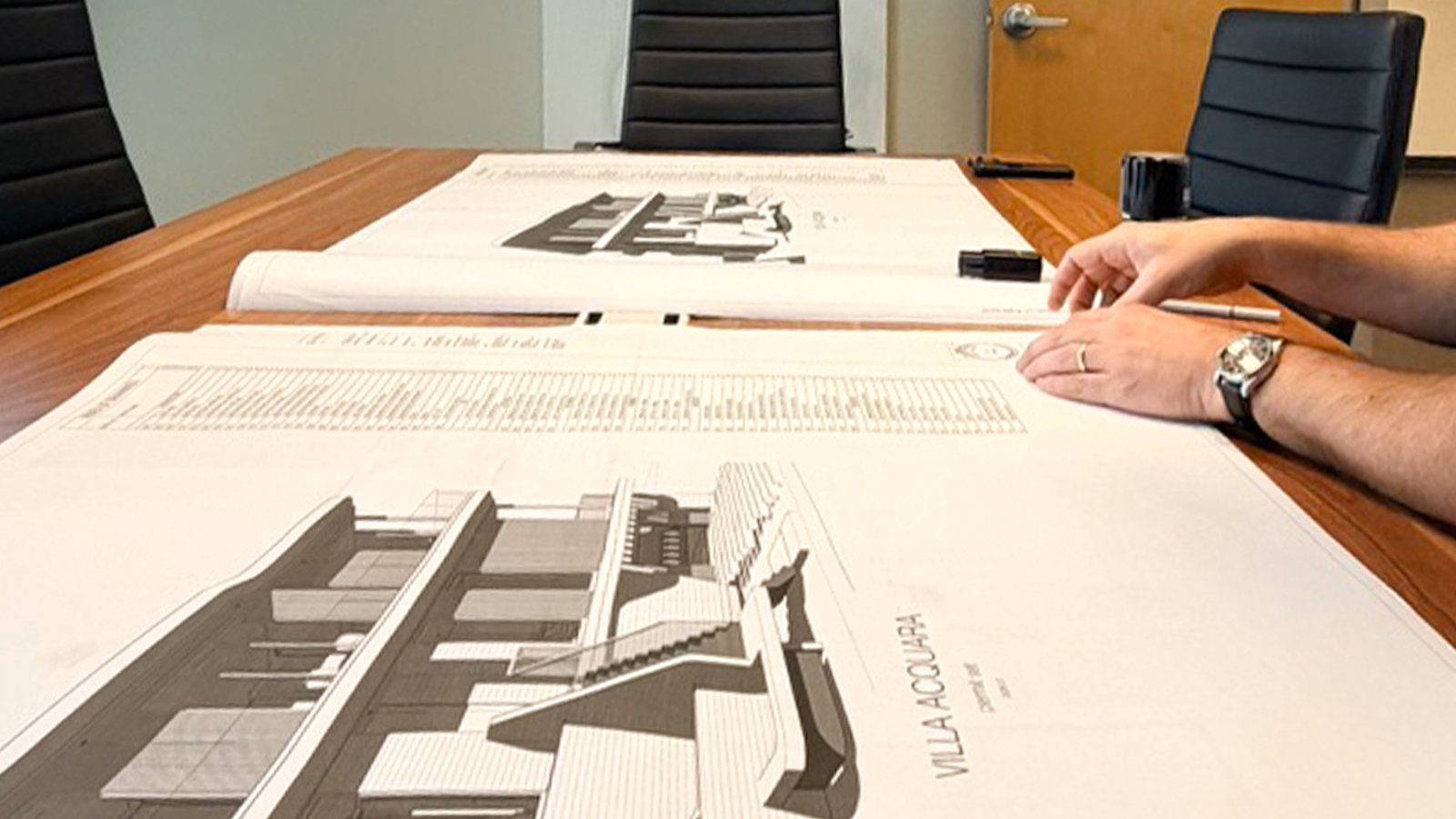
For Villa Acquara, that moment involved an intensive period of preparation at our studio. As the project approached its City of Miami permitting submission, our team came together to review, organize, sign, stamp, and assemble the physical construction document package required for this particular submission.
It was a process involving numerous drawing sheets, careful reviews, and a shared responsibility to ensure that every document was properly prepared.
The location and applicable submission requirements for Villa Acquara called for physical construction documents rather than an electronically signed submission package. This meant that our team had to dedicate additional attention to the manual preparation and organization of the complete set.
Page after page, each drawing was reviewed and signed, professional seals were applied where required, and the documents were carefully organized into the final package.
These may seem like simple tasks, but they represent something much larger: the responsibility architects carry when translating a design into a complete, coordinated, and professionally prepared submission.
Behind every sheet is a decision. Behind every detail is coordination. And behind every submission is a team working toward the same objective.
Coordination Is More Than Putting Drawings Together
One of the most important aspects of architectural practice is understanding that a building is never the result of one discipline working independently.
Architecture connects structure, mechanical systems, electrical layouts, plumbing, site conditions, code requirements, and many other technical considerations. Every discipline contributes information that must ultimately work together as one project.
This coordination begins well before the final documents are assembled.
As architects, we must continuously review the information being developed, communicate with consultants, identify discrepancies, and ensure that the different components of the project remain aligned with the original design intent.
For a developer, this coordination has practical consequences.
A discrepancy between architectural and engineering information can lead to additional questions, revisions, and potentially avoidable delays. An unresolved design decision can affect multiple disciplines. A lack of communication between project participants can create challenges that become more complicated as the project advances.
The architect's responsibility is to help maintain a clear direction throughout this process.
At Ginard Studio, we believe that good coordination is not simply about completing a checklist. It is about understanding how every decision affects the project as a whole.
The Value of an Architect Who Stays Involved
For developers, selecting an architectural firm should not be based exclusively on design portfolios or visual presentations.
The ability to manage the process behind the design is equally important.
An architectural partner should understand the relationship between the initial concept, the regulatory environment, technical coordination, construction documentation, and eventual execution.
This is particularly relevant in Miami, where development projects must respond to specific zoning conditions, local requirements, and the coordination of multiple professionals and reviewing authorities.
Our full-service approach allows us to remain involved throughout the different phases of a project, from conceptual design and planning through permitting and construction administration.
This continuity helps preserve the original vision while addressing the technical and practical considerations that emerge along the way.
We also integrate Revit-based BIM into our architectural workflow, supporting coordination between disciplines and helping our team identify potential conflicts before they become construction challenges.
For developers, the value is not simply in having a complete set of drawings. It is in having an architectural team that understands the responsibility behind those drawings and how they contribute to the broader development process.
From Preparation to Performance: Thinking Beyond Permitting
A permitting submission is an important milestone, but it is not the final objective.
The ultimate goal is to move a project toward construction with a coordinated design, clear documentation, and a team prepared to address the decisions that will inevitably arise during implementation.
This is why the work performed before submission matters so much.
The time invested in coordination, reviewing documents, communicating with consultants, and resolving details establishes a stronger foundation for the next stages of development.
While no preparation process can eliminate every review comment or construction challenge, a disciplined approach helps reduce avoidable inconsistencies and creates better conditions for project execution.
For developers and investors, this translates into something particularly valuable: greater confidence in the process.
We approach architecture with this broader perspective. We understand that design quality, technical coordination, and project execution are interconnected. Each phase contributes to the success of the next.
Preparation Is Part of the Investment Strategy
Villa Acquara reminds us that some of the most important work in architecture happens outside the spotlight.
It happens around a table covered with drawings, during conversations between architects and consultants, in the careful review of individual sheets, and through the collective effort of a team preparing a project for its next milestone.
These moments may not appear in architectural renderings, but they are fundamental to bringing a project forward.
For developers, the lesson is clear: architectural coordination should not be considered an administrative step or an expense at the end of the design process. It is an investment in the quality, clarity, and continuity of the project.
A well-coordinated architectural process supports better decisions, helps manage project risk, and establishes a stronger foundation for construction.
Because successful development is not only about what you build. It is also about how well you prepare to build it.
At Ginard Studio, we believe that architecture begins with vision, advances through coordination, and delivers value through execution.
Architecture that performs at every level.